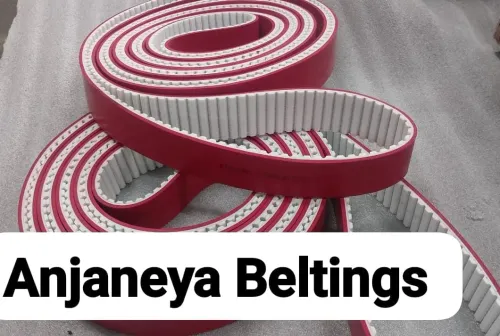
Polyurethane (PU) timing belts with a top silicone coating combine the precise power transmission and wear resistance of a toothed PU belt with higher surface grip, lower noise, and better heat or chemical resistance on the back side. Key Specifications • Base Belt Material: Thermoplastic polyurethane (PU), typically around 70–90 Shore A hardness, with steel, Kevlar/aramid, or fiberglass tension cords. • Common Tooth Profiles: Metric profiles (such as T2.5, T5, T10, T20, AT5, AT10, AT20), imperial profiles (XL, L, H, XH), and curvilinear profiles (such as HTD). • Silicone Coating Thickness: Typically ranges from 0.5 mm to 12 mm depending on the manufacturer and conveyor/grip requirement (commonly 1.5 mm to 10 mm on standard custom belts). • Coating Hardness: Often softer than the PU base (for example, around 35–40 Shore A) to increase surface friction, cushioning, and anti-slip grip. • Temperature Resistance: Uncoated standard PU belts generally operate around -30°C to +80°C, whereas specialized silicone formulations can extend high-temperature tolerance up to 100°C–250°C depending on the exact compound and construction.
Chennai
+919381438079
 Chat with us
 Chat with us